Behind the glove box in most cars sits a filter you've probably never looked at. Every breath you take on the road passes through it first. Keeping it fresh costs most drivers $15 to $50 a year when they swap it themselves, or $60 to $130 a year at a shop. Smoke seasons, heavy pollen, gravel roads, and high mileage can double that.
I write a lot here about the filter in your home's HVAC system. Your car carries a smaller version that does the same job for every vent, and it protects the people riding with you only when it gets changed on time. The habits carry over, so if you already watch for the signs it's time to replace your furnace air filter, you're halfway there.
TL;DR Quick Answers
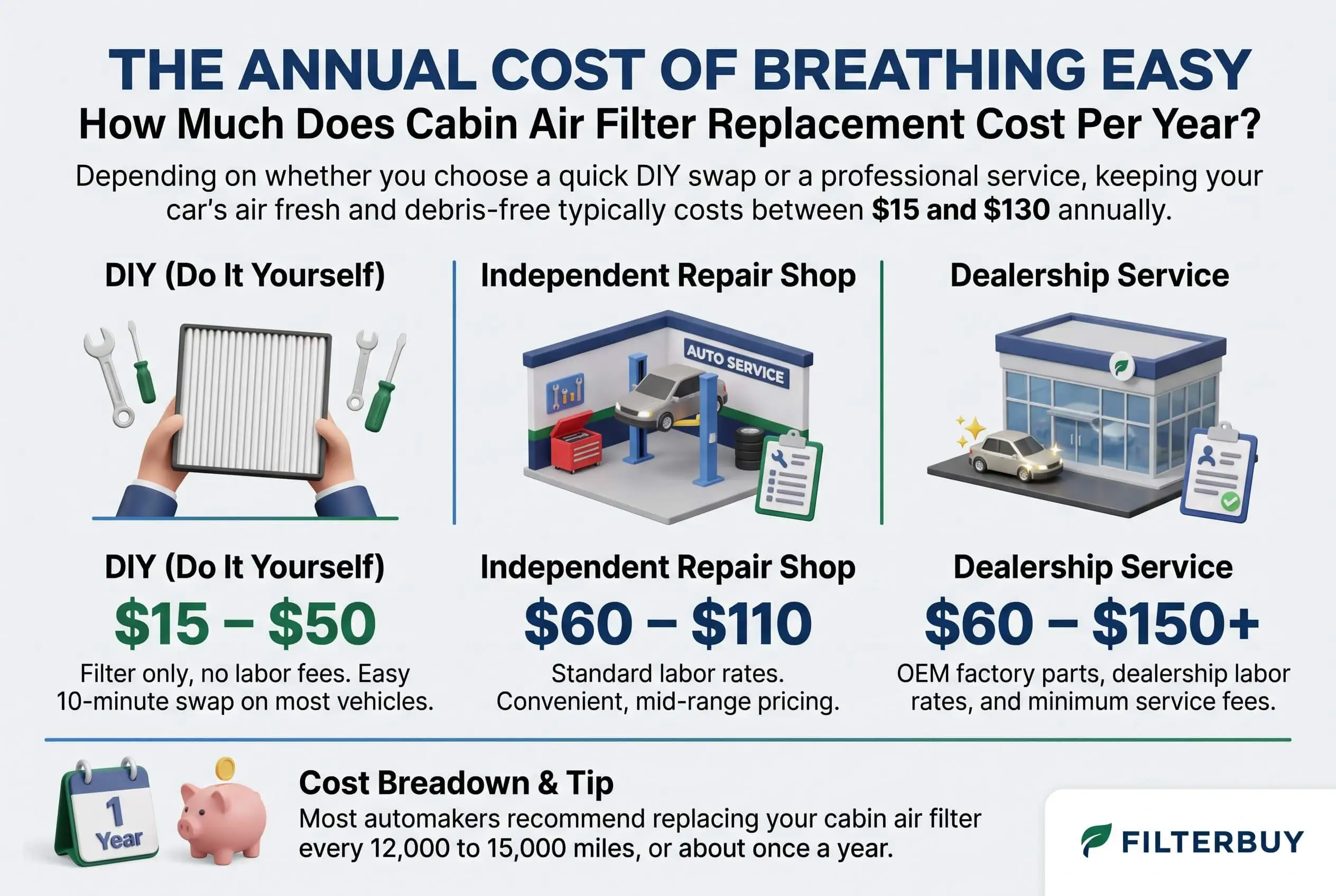
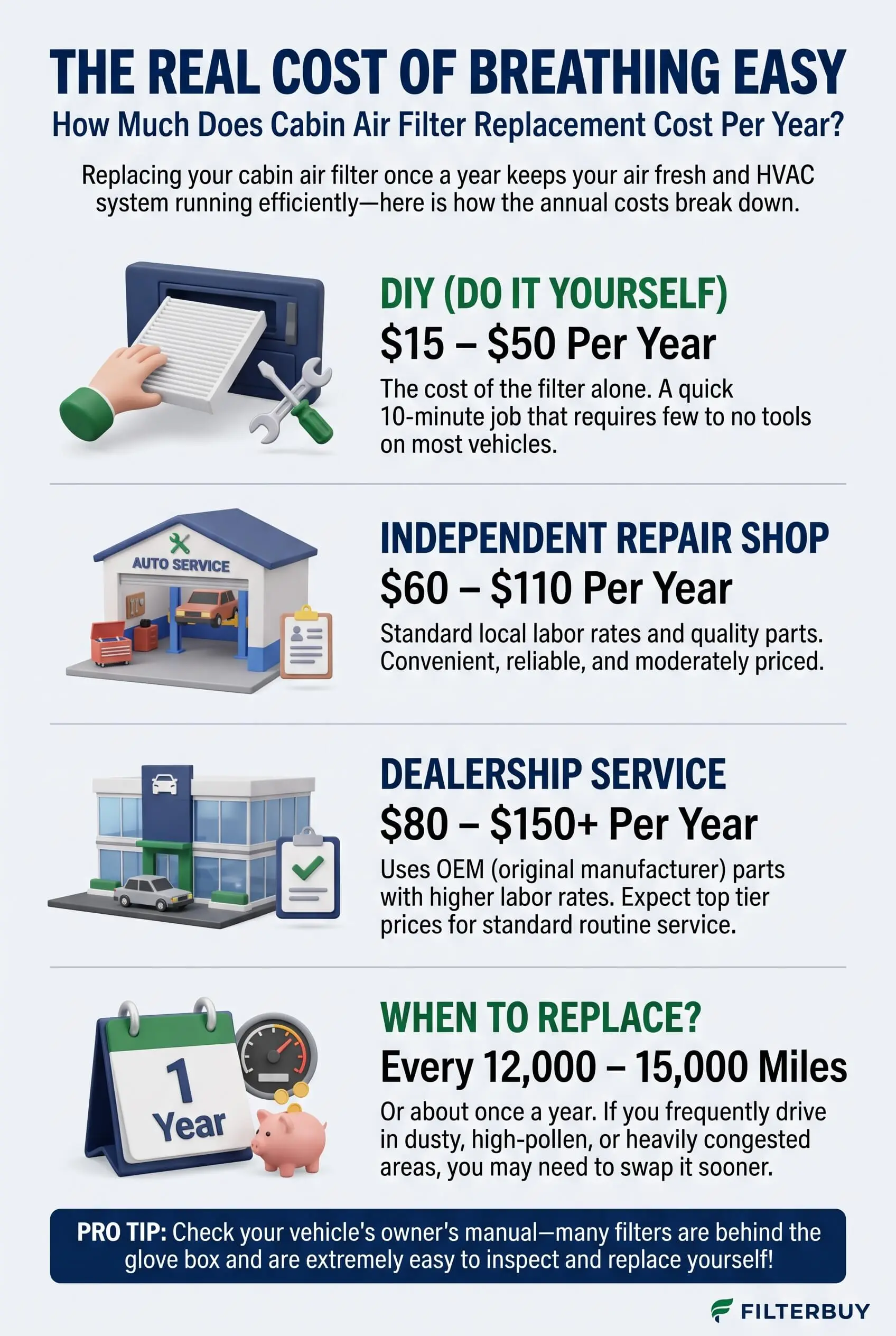
Cabin air filter replacement costs $15 to $50 when you install the filter yourself and $60 to $130 at a shop, with dealers at the high end or above. The filter is cheap, so labor drives the bill. If yours sits behind the glove box, a few minutes of DIY saves most of the cost.
Do it yourself: $15 to $50, the price of the filter alone.
Shop: $60 to $130, with roughly half the bill going to labor.
Dealership: The top of that range or higher, driven by bigger hourly rates and labor minimums.
Per year: One change every 12,000 to 15,000 miles for most drivers. Smoke, heavy pollen, or high mileage can mean two.
Quick check: Find the filter in your owner’s manual first. Behind the glove box means it’s an easy DIY job.
Top Takeaways
Plan on $15 to $50 a year if you change the filter yourself, or $60 to $130 a year at a shop, based on one change a year.
Replace it every 12,000 to 15,000 miles or once a year, whichever comes first.
Budget for two changes if you drive through smoke, heavy pollen, dusty roads, or more than 25,000 miles a year. That runs $30 to $260 depending on who does the work.
Over five years, DIY costs $75 to $250 compared with $300 to $650 at a shop.
Do the labor yourself, or bring your own filter to the shop, for the biggest savings.
Add about 5% a year to cover rising maintenance and repair prices.
What One Cabin Air Filter Replacement Costs
Swapping the filter yourself costs $15 to $50, which is just the price of the part. A shop charges $60 to $130 for the same job, and dealerships usually sit at the top of that range or above it.
The part is cheap. Labor is where the bill grows, and labor depends on where your car hides the filter housing. Most cars tuck it behind the glove box, where it slides out in a few minutes, while others bury it under the dash or below the windshield cowl and charge you for the extra reach. You can check typical cabin air filter replacement cost by vehicle, including how much of a shop bill goes to labor.
How Many Times a Year You'll Pay for One
Plan once a year. Most automakers call for a fresh filter every 12,000 to 15,000 miles or every 12 months, whichever comes first. The average American driver covers about 13,476 miles a year, according to the Federal Highway Administration, which lands squarely inside that window.
Picture a pleated screen sitting in your car's outside-air intake. It catches dust, pollen, and road debris before any of it reaches your vents. As it clogs, airflow drops and both the A/C and the heater lose strength. This overview of automotive cabin air filters shows how they're built and where they sit.
Some driving conditions load a filter faster and can push you to two changes a year:
Wildfire smoke. Smoke packs a filter quickly. The EPA recommends closing your windows and running the A/C on recirculation when smoke rolls in, and I'd check the filter as soon as the air clears.
Heavy pollen. A bad spring or fall can turn a white filter gray months before the mileage mark.
Dusty and gravel roads. Rural routes and construction zones clog filters fast.
Stop-and-go city traffic. You pull in more exhaust and road grit for every mile you drive.
High mileage. Rideshare drivers and long-distance commuters can top 25,000 miles a year.
Your Yearly Budget, by Driver Type
I set my own number with a simple formula. Multiply the cost per change by the changes per year, then by the number of cars in the driveway.
Low-Mileage Driver
Under 10,000 miles a year, the calendar matters more than the odometer. A parked car's filter still collects moisture and grime, so one change a year makes sense. Budget $15 to $50 if you do it yourself or $60 to $130 at a shop.
Average Commuter
Between 12,000 and 15,000 miles a year, you're right in the standard window. One change covers you, and pairing it with an oil change means one less thing to remember. Your yearly range matches the low-mileage driver's: $15 to $50 DIY or $60 to $130 at a shop.
High-Exposure or High-Mileage Driver
Smoke seasons, rough allergy seasons, or 25,000-plus miles call for two changes a year. That puts you at $30 to $100 doing it yourself, or $120 to $260 at a shop.
Two things multiply any of these numbers. Every extra car in the household adds its own budget, and some models run two cabin filters that get replaced together, which doubles the parts cost on each visit.
The Five-Year Cost: DIY Versus Shop
Five years of once-a-year changes comes to $75 to $250 if you handle it yourself and $300 to $650 if a shop does. For a job most people finish in a few minutes, that gap of roughly $225 to $400 is worth knowing about.
I'd pad the shop budget by about 5% a year. Vehicle maintenance and repair prices jumped 4.9% between January 2025 and January 2026, according to the Bureau of Transportation Statistics, so last year's quote probably runs low.
What Pushes Your Yearly Cost Higher
Filter media. Basic particulate filters cost the least. Activated carbon filters, which also trap odors, and HEPA-grade filters cost more each time.
Where the housing sits. A filter under the dash or cowl takes longer to reach, and you pay for that time.
Dealer labor rates. Dealers often bill a higher hourly rate plus a labor minimum, so a short job gets billed like a longer one.
Two-filter vehicles. Some models need a pair, which doubles the parts line.
Rising service prices. Repair and maintenance costs keep climbing faster than plenty of other household bills.
Easy Ways to Spend Less Each Year
Do it yourself when the filter lives behind the glove box. Your owner's manual shows exactly where it sits.
Bring your own filter. Plenty of shops will install a part you supply, which cuts out their markup.
Ask for a written estimate. Have the shop list parts and labor separately so you can see what the labor costs on its own.
Look at the old filter first. If it still looks clean, it may have more life left.
Pair the change with an oil change. One visit and one reminder keep it from slipping.
Keep a spare on the shelf. Filters store well, and buying two at once can save on shipping and a second trip.
Is Skipping a Replacement Worth the Savings?
For most drivers, no. Skipping a year saves $15 to $50 if you'd normally do the swap yourself. In exchange, you get weaker airflow from the vents, an A/C and heater working harder, musty smells, and more pollen and fine dust in the air your family breathes on every drive. Anyone who has run a home system on a neglected filter knows that feeling, and this look at running your AC without a filter explains why it happens.
"Over my years pulling cabin filters, the costliest ones I've seen were cheap filters left in for two or three years. By then they're packed so tight with pollen and road grit that the blower strains to push air across the evaporator, and drivers pay for that strain later with a weak A/C and a bigger repair bill."
7 Essential Resources
Bookmark these before your next filter change, whether you're paying a shop or doing it yourself.
1. See Prices for Your Exact Vehicle
This cabin air filter replacement cost guide breaks down per-visit prices by vehicle and shows how much of a shop bill goes to labor.
2. Know What a Fair Estimate Includes
The FTC's Auto Repair Basics spells out what a written estimate should list, and why your owner's manual schedule should win over a shop's own schedule.
3. Keep Smoke Out of Your Car
The EPA's Reduce Your Smoke Exposure fact sheet tells drivers to close the windows and switch to recirculate mode when wildfire smoke moves in.
4. Plan for Smoke Season in More Depth
AirNow's Wildfire Smoke Guide for Public Health Officials includes a section on cutting smoke inside vehicles.
5. Connect Maintenance to Fuel Savings
Energy Saver's Consumer Guide to Fuel Economy Fact Sheet shows how routine upkeep and driving habits change what you spend at the pump.
6. Understand Your Rights at the Repair Shop
Washington Law Help's auto repairs guide walks you through written estimates, itemized invoices, and your right to see the parts a shop replaced.
7. Spot an Auto Repair Rip-Off
The Howard County Office of Consumer Affairs explains how to read a repair authorization form, and why you should ask for old parts back, in Avoiding Auto Repair Rip-Offs.
3 Statistics
4.9%. Motor vehicle maintenance and repair prices rose this much from January 2025 to January 2026, more than any other item pushing inflation up that month. Older cost estimates now run low. (Bureau of Transportation Statistics)
13,476 miles. The average American driver covers this distance in a year. It falls right inside the 12,000 to 15,000 mile replacement window, so one change a year fits most people. (Federal Highway Administration)
$13,318. U.S. households spent this on transportation in 2024, about 17% of all their spending. A full year of cabin air filters barely registers against it. (Bureau of Labor Statistics)
With vehicle maintenance costs rising 4.9% and Americans driving an average of 13,476 miles annually, replacing cabin air filters once a year is a simple, affordable way to maintain cleaner air in your car, much like regular air duct cleaning helps address dust buildup in your home's HVAC system.
Final Thoughts and Opinion
Most drivers spend $15 to $50 a year on cabin air filters when they do the swap themselves, and $60 to $130 when a shop handles it. Labor moves that number far more than the filter you pick.
Here's where I land. If your filter sits behind the glove box, learn to change it yourself. Few car jobs let a few minutes of your time cut most of the bill, and across five years those savings reach a few hundred dollars. When the filter is buried under the dash, paying a shop is fair. Get a written estimate, bring your own filter where the shop allows it, and ask to see the old one before you pay.
I treat this filter like the one in my home's HVAC system, cheap to replace and expensive to ignore. One calendar reminder a year, plus a quick look after smoke or pollen season, keeps the cost small and your family's air cleaner on every drive.
Frequently Asked Questions
Is a Cabin Air Filter Replacement Worth Paying a Shop For?
That depends on where your filter sits. Behind the glove box, most people can swap it in minutes without tools, so most of a $60 to $130 shop bill goes to labor. Under the dash or cowl, a shop makes sense, because a handful of broken trim clips can cost more than the labor you'd save.
Can I Go Two Years Without Replacing My Cabin Air Filter?
You can, but I wouldn't plan on it. After a year, most filters hold enough pollen, dust, and debris to cut airflow and make your A/C and heater work harder. Low-mileage drivers still benefit from a yearly change, because the filter keeps collecting moisture and grime even while the car sits parked.
Does a HEPA or Carbon Cabin Filter Cost More Per Year?
Yes. Basic particulate filters cost the least, and activated carbon or HEPA-grade filters cost more per change because of the extra media. For drivers dealing with smoke, odors, or allergies, the upgrade often pays off in comfort. Your yearly cost goes up by the price difference times the number of changes you make.
Why Did the Dealer Quote More Than $100?
Dealerships often charge higher hourly labor rates than independent shops, and many apply a labor minimum, so a short job bills like a longer one. Some also use factory filters with a bigger markup. Ask for a written estimate with parts and labor listed separately, then compare it with an independent shop's quote.
Does Replacing the Cabin Air Filter Myself Void My Warranty?
Generally, no. Federal law keeps a manufacturer from voiding your warranty just because you did routine maintenance yourself or used aftermarket parts, unless that part caused the damage. Keep your receipt and jot down the date and mileage so you have a simple maintenance record.
Set Your Cabin Air Filter Budget for the Year Ahead
Swapping the filter yourself keeps a full year of cleaner cabin air under the price of one tank of gas. You can also compare prices and buy replacement filters online to save more on maintenance costs. Check your mileage and driving conditions, match them to a driver profile above, and put that yearly number on your calendar.


