What separates a 20x25x1 HVAC home air filter that genuinely helps an allergy household from one that only looks the part is a specific combination of MERV rating, media construction, and replacement schedule. Know what those three mean on the label and you can make a choice that holds. Get one wrong and the protection isn’t there.
TL;DR Quick Answers
20x25x1 HVAC home air filter
The 20x25x1 is one of the most common residential HVAC filter sizes in the U.S. It measures 20 inches wide by 25 inches tall by 1 inch deep (nominal dimensions) and fits the return-air slot in a wide range of home furnaces and air handlers. After manufacturing filters for over a decade, it's also the size we see most often purchased at the wrong MERV rating for the household's actual needs.
MERV rating guide for 20x25x1 filters:
MERV 8 — captures pollen, coarse dust, and mold spores; adequate for standard households
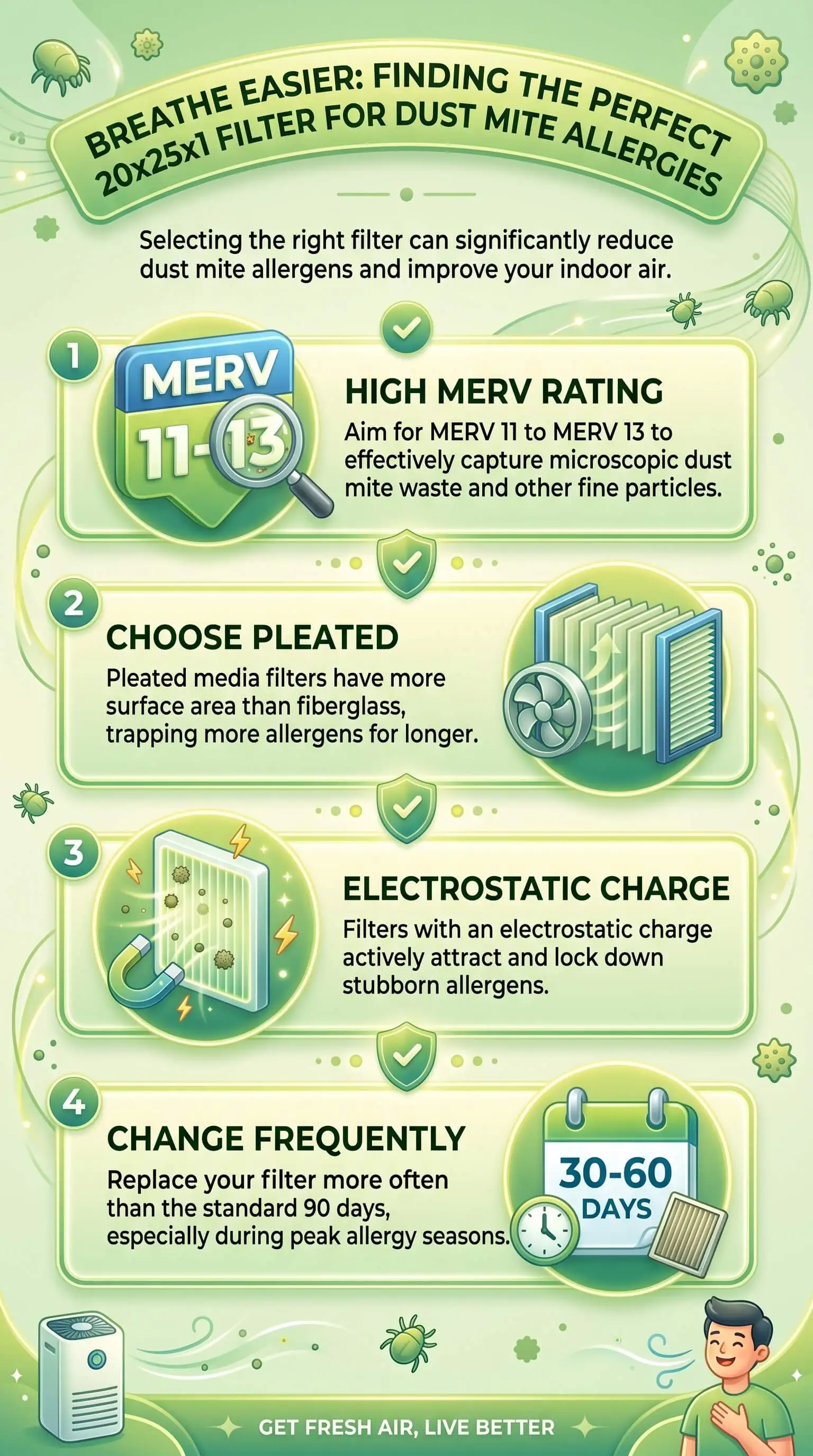
MERV 11 — minimum recommended for dust mite allergy, pet dander, or any occupant with respiratory sensitivities
MERV 13 — highest standard residential filtration; removes 85% or more of fine particles in the 1–3 micron range
Media and replacement:
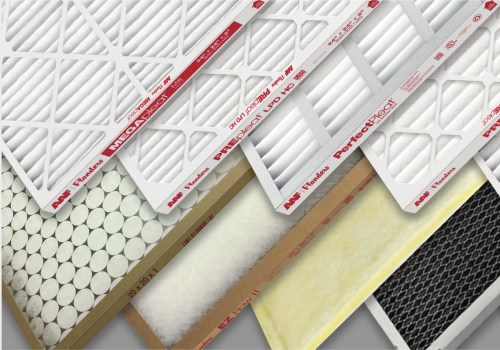
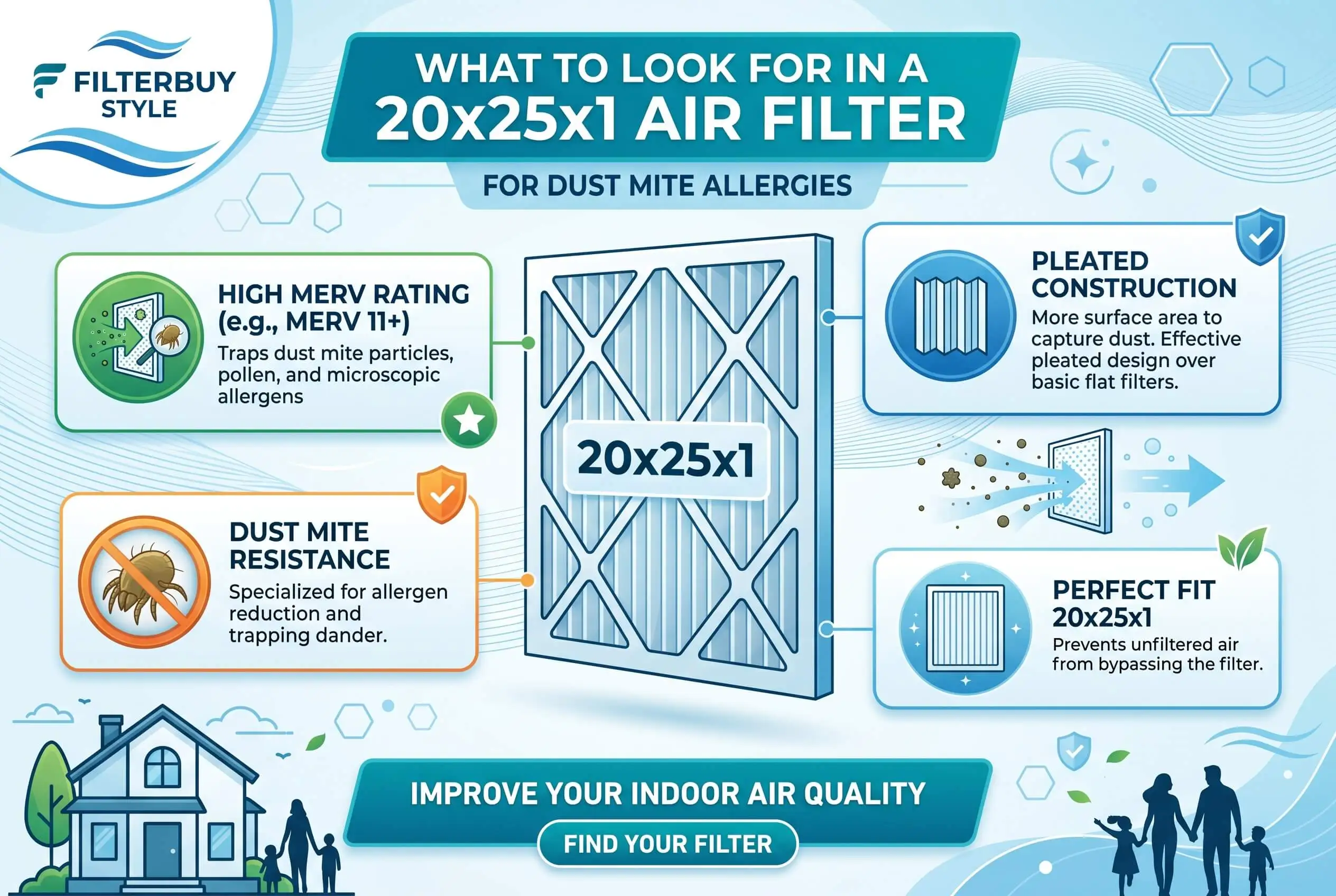
Choose pleated media over fiberglass — pleat count determines capture surface area at 1-inch depth
Standard households: replace every 60–90 days
Allergy households or homes with pets: replace every 30–45 days
Browse 20x25x1 air filters sized, rated, and ready to ship.
Top Takeaways
Dust mites don’t cause allergic reactions directly. Their waste particles and shed body fragments do — and those become airborne through everyday household activity and HVAC operation.
MERV 11 is the minimum for a dust mite allergy household. It captures the one-to-three micrometer range where most allergen fragments fall, and MERV 13 pushes that capture efficiency to 85 percent or better.
Pleated media in a 20x25x1 filter outperforms fiberglass alternatives in the same size because pleat count determines the actual capture surface area available to the airstream, not just the MERV number on the label.
Replace a 20x25x1 filter every 30 to 45 days in an allergy household, not the standard 60 to 90. Higher allergen loads cause faster filter loading, and a clogged filter pushes trapped particles back into the airstream.
A filter that blocks all visible light when held up to a source should be replaced immediately, regardless of when it was last changed.
Confirm exact nominal dimensions before purchasing. A filter that seats loosely in the return-air slot allows unfiltered air to bypass the media entirely, defeating the purpose of a higher-rated filter.
The MERV rating on the label should be a specific number tested under ASHRAE Standard 52.2, not a marketing descriptor without a quantified standard behind it.
What Dust Mites Are and Why Your Filter Is the First Line of Defense
Dust mites are microscopic, but what they leave behind is not. Their waste particles and shed body fragments — the proteins that trigger the immune response in allergy-sensitive people — collect in bedding, carpet, and upholstered furniture, then go airborne whenever those surfaces get disturbed.
Your HVAC system draws air from every room in the house across the air filter and redistributes it through the living space dozens of times each day. Every pass is an opportunity to pull those particles out of circulation. Whether that actually happens depends on what the filter is rated to capture.
The 20x25x1 is one of the most common nominal return-air filter dimensions in U.S. homes, running at a standard one-inch depth. That depth limits how much filter media fits in the frame, which makes construction quality and MERV rating more consequential in this size than in thicker filter formats.
The MERV Rating That Actually Matters for Dust Mite Allergens
After manufacturing filters for over a decade and serving more than two million households, one pattern stands out: allergy households consistently select a MERV rating that’s too low for the problem they’re trying to solve.
A MERV 8 filter captures pollen, coarse dust, and mold spores well. Those particles fall mostly in the three-to-ten micrometer range, and MERV 8 was designed for that. Dust mite allergen fragments land in the one-to-three micrometer range, where a MERV 8 captures very few of them. For an allergy household, MERV 8 is the wrong starting point.
MERV 11 is the working minimum. It captures the one-to-three micrometer range at meaningful efficiency, which is where most airborne allergen fragments from dust mites concentrate. MERV 13 pushes the capture rate for that same size range to 85 percent or better. The trade-off is airflow resistance: denser filter media means the blower works harder. In older or lower-capacity HVAC systems, a MERV 13 can restrict airflow enough to strain the unit. If your system falls in that category, start with a MERV 11 filter and confirm with an HVAC technician before going higher.
Filter Thickness and Media Type: What Changes in a 20x25x1
At one-inch nominal depth, the 20x25x1 slot doesn’t leave much room for filter media to work. That physical constraint is what makes construction type — not just MERV rating — the deciding factor between filters that look equivalent on the shelf and perform very differently in the system.
Fiberglass and flat-panel filters in this size can’t reliably intercept submicron particles. The fiber structure is too coarse and the media surface area too limited, regardless of what the packaging suggests. Pleated media addresses this by folding the filtration material into a series of peaks and valleys that multiply the capture surface within the same frame depth.
Pleat count within the frame determines how much of that surface area you actually get. More pleats means more media in contact with the airstream, which translates to better particle capture per cubic foot of air moving through. When comparing 20x25x1 filters for dust mite allergen reduction, look for pleated media and a confirmed MERV rating. A filter that claims allergen capture without a specific MERV number hasn’t been independently evaluated against the particle sizes that matter and shouldn’t be trusted for an allergy household.
How Often to Change a 20x25x1 Filter When Allergies Are a Factor
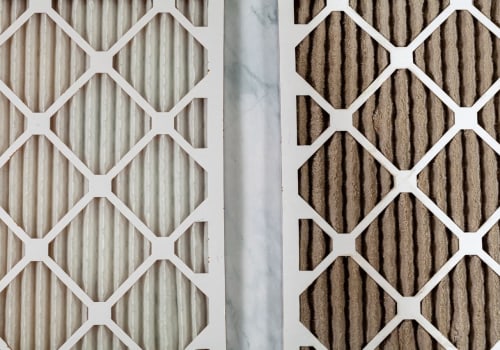
The standard 60-to-90-day replacement schedule works for homes without significant air quality pressures. A dust mite allergy household is a different situation. Higher allergen loads mean the filter accumulates particles faster, and a filter at capacity doesn’t just stop working — it starts pushing particles it already trapped back into the airstream.
For homes where one or more occupants manage dust mite allergies, 30 to 45 days is the right replacement window. Add pets or higher occupancy and the shorter end of that range applies. The filter carries a heavier load than the packaging assumes, and treating it as a routine 90-day part creates gaps in protection.
Pull the filter out and hold it up to a light source. If light doesn’t pass through clearly, replace it now — whatever the calendar says. Seasonal conditions, occupancy patterns, and how often the HVAC system runs all affect how fast the media loads up. The replacement schedule is a guideline, not a promise.
What to Look for on the Label When Buying a 20x25x1 HVAC Home Air Filter
Reading a filter label for a dust mite allergy household doesn’t require an engineering background. Four things matter on the packaging.
The MERV rating should appear as a specific tested number — 11 at minimum. If the filter uses language like “advanced allergen protection” without a MERV designation, it hasn’t been independently evaluated against the particle sizes that trigger dust mite allergy symptoms.
The media should be pleated. That construction gives the filter enough capture surface to work at one-inch depth.
The nominal dimensions need to be an exact match for your return-air slot — the full 20x25x1 designation, not a general “fits 20x25” claim. A filter that doesn’t seat flush allows unfiltered air to route around the media, which defeats a higher MERV rating as effectively as choosing the wrong one.
The brand should publish its tested filtration performance rather than rely on marketing language without a third-party standard behind it.
Once you know what those labels mean, the selection gets straightforward. Browse 20x25x1 air filters sized and rated for households where dust mite allergen control is part of the daily routine.
“In our production testing, a high-pleat-count MERV 11 at one-inch depth consistently outperforms a flat or low-pleat MERV 13 of the same nominal size in real-world dust mite particle capture, because pleat count determines the actual media surface area available for filtration. The MERV rating tells you what the filter can do; the construction tells you whether it can sustain that performance through a full service cycle.”
7 Essential Resources
The sources below come from federal health agencies and established non-profit organizations. Each one is cited for a specific reason.
How Biological Pollutants Move Through Your Home’s Air System
The EPA explains how biological contaminants, including dust mites, enter and circulate through residential environments through inadequately maintained HVAC systems and contaminated central air handling equipment. This resource clarifies the mechanics of allergen redistribution and recommends practical humidity and ventilation controls.
Source: Biological Pollutants’ Impact on Indoor Air Quality — U.S. Environmental Protection Agency
Dust Mite Allergy: Triggers, Diagnosis, and What Reduces Exposure
The Asthma and Allergy Foundation of America covers the biology, allergen mechanics, and clinical diagnosis of dust mite allergy in plain language. The resource addresses why year-round symptoms differ from seasonal allergies and what environmental controls, including proper AC filter use, reduce exposure at home.
Source: Dust Mite Allergy — Asthma and Allergy Foundation of America
What NIEHS Research Has Found About Dust Mite Allergen Reduction
The National Institute of Environmental Health Sciences summarizes its funded research on dust mite populations, allergen proteins, and home-based intervention strategies, including dehumidifier use and in-home test kits. The source connects the scientific understanding of allergen density to practical reduction tactics.
Source: Dust Mites and Cockroaches — National Institute of Environmental Health Sciences
Why Dust Mite Allergens Are a Major Indoor Asthma and Allergy Trigger
The American Lung Association’s resource on dust mites explains how mite body fragments and fecal particles cling to soft surfaces and enter the airstream during routine household activity. It outlines exposure reduction strategies recommended by the Institutes of Medicine, EPA, and CDC.
Source: Dust Mites — American Lung Association
The EPA’s Homeowner Guide to Indoor Air Quality
This EPA resource provides household-level guidance on biological pollutants, humidity management, and HVAC maintenance. It addresses how damp, warm environments accelerate dust mite population growth and how ventilation practices affect the concentration of airborne allergens throughout the home.
Source: The Inside Story: A Guide to Indoor Air Quality — U.S. Environmental Protection Agency
ASHRAE’s Filtration Standards and What MERV Ratings Mean in Practice
ASHRAE, the engineering society that established the MERV standard, publishes filtration guidance explaining particle size capture ranges and the practical trade-offs between filter efficiency and HVAC system airflow. If you want to understand how MERV ratings are actually tested and what the numbers mean in a real system, this is the primary source.
Source: Filtration and Disinfection FAQ — ASHRAE
Indoor Allergens as a Major Asthma Trigger: What the Research Shows
The NIEHS asthma research hub summarizes clinical findings on how indoor allergens, including dust mites, affect airway inflammation and asthma severity. It provides context for why reducing airborne allergen load matters not only for allergy sufferers but for anyone in the household with asthma.
Source: Asthma — National Institute of Environmental Health Sciences
Supporting Statistics
These numbers come from federal health agencies and established research. They confirm what we see across the households we’ve served.
The Allergen Threshold That Defines a High-Risk Home
The EPA identifies two established thresholds for mite allergen exposure: chronic exposure at 100 mites per gram of dust (or 2 micrograms of Der p I allergen per gram) can begin sensitizing allergy-prone individuals, while exposure at 500 mites per gram (or 10 micrograms) creates risk of acute asthma attacks in those already sensitized. Bedrooms and upholstered furniture frequently exceed those levels in homes with active dust mite populations. An HVAC filter at MERV 11 or above, combined with regular air duct cleaning, pulls a portion of the airborne allergen load out of the system with every cycle, reducing cumulative exposure over time.
One Person Sheds Enough Skin Daily to Feed One Million Dust Mites
The AAFA reports that the average adult sheds up to 1.5 grams of skin flakes each day. That’s enough, by itself, to sustain a population of one million dust mites. Dust mites may be the most common trigger of year-round allergies and allergic asthma, and they’re present on every continent except Antarctica. In homes with multiple occupants, the available food source scales with the headcount, which means populations build faster and airborne allergen loads stay consistently elevated. Filters that load up quickly in these homes aren’t failing — they’re working. They just need to be replaced on a shorter cycle.
Source: Fact or Fiction: 5 Myths About Dust Mites — Asthma and Allergy Foundation of America
MERV 13 Captures 85 Percent or More of the Particles That Carry Dust Mite Allergens
ASHRAE’s filtration guidance confirms that MERV 13 filters remove 85 percent or more of particles in the one-to-three micrometer size range. Dust mite allergen fragments, including the proteins Der p 1 and Der f 1 that trigger immune responses in sensitized individuals, fall heavily within that range. A MERV 11 captures a significant share of those same particles, making it the practical minimum for allergy households. In systems where a MERV 13 would restrict airflow, a pleated MERV 11 replaced on a shortened schedule delivers most of the same protection without straining the blower.
Source: Filtration and Disinfection Guidance — ASHRAE
Final Thoughts and Opinion
Managing dust mite allergies at home is a series of layered decisions, not a single-product fix. The 20x25x1 HVAC home air filter handles the airborne fraction of allergens that mattress covers and hot-water laundry cycles can’t reach, and it works quietly, every hour the blower runs.
A MERV 11 pleated filter replaced every 30 to 45 days keeps recirculated air genuinely cleaner between changes. A lower-rated or irregularly changed filter won’t. That difference shows up in how the household actually feels — in fewer symptoms, better sleep, and fewer days reacting to what a well-chosen filter could have caught.
That consistency matters more than most people expect. Allergy symptoms don’t usually spike from one bad day of exposure. They build from the steady background load that an overdue or underperforming filter quietly fails to reduce. No filter eliminates dust mites — nothing does, short of moving to Antarctica. But the right 20x25x1 pulls a meaningful share of what those mites leave behind out of the air your family breathes, and in an allergy household, that’s worth measuring.
Frequently Asked Questions
Q: What MERV rating do I need for a 20x25x1 filter if I have dust mite allergies?
A: MERV 11 is the minimum for a dust mite allergy household. It captures particles in the one-to-three micrometer range where most airborne allergen fragments fall. If your HVAC system can handle the additional airflow resistance, MERV 13 captures that same size range at 85 percent efficiency or better. Check your system’s documentation or ask your HVAC technician before upgrading to MERV 13 in an older or smaller-capacity system.
Q: How often should I change my 20x25x1 air filter if someone in my home has dust mite allergies?
A: Every 30 to 45 days, rather than the standard 60 to 90. Allergy households generate more airborne particles that load the filter faster. A clogged filter doesn’t just stop capturing new particles. It can push particles already trapped near the surface back into the airstream. If the home also has pets or multiple occupants, change at the 30-day mark.
Q: Can a 20x25x1 filter actually reduce dust mite allergy symptoms?
A: Yes, when the right filter is selected and replaced on schedule. Dust mite allergen particles become airborne during normal household activity, and every HVAC cycle pulls them through the system. A MERV 11 or higher pleated filter captures a significant portion of those particles with each pass. Symptom reduction is gradual and cumulative, not immediate, and the filter works best as part of a broader strategy that includes allergen-proof mattress covers and regular hot-water washing of bedding.
Q: What is the difference between MERV 8, MERV 11, and MERV 13 for dust mite allergens?
A: The differences come down to which particle sizes each rating is designed to capture:
MERV 8 targets particles in the three-to-ten micrometer range: pollen, coarse dust, mold spores. It captures very few of the smaller allergen fragments produced by dust mites.
MERV 11 adds meaningful efficiency in the one-to-three micrometer range, where most airborne dust mite allergen particles fall. This is the minimum for an allergy household.
MERV 13 captures 85 percent or more of the one-to-three micrometer range and begins addressing finer particles as well. It provides the highest protection among standard residential filter ratings but creates more airflow resistance.
Q: Will a higher MERV filter damage my HVAC system?
A: A higher MERV filter creates more airflow resistance. That’s not damage in itself. The concern is that an underpowered or older HVAC system may not push enough air through a denser filter, which reduces heating and cooling efficiency and can stress the blower motor over time. Check your system’s documentation for its maximum rated MERV, or start with MERV 11 and monitor whether the system maintains normal airflow and temperature control. Replacing the filter on schedule also matters — a loaded filter in any MERV rating creates more resistance than a clean one.
Q: What size is a 20x25x1 air filter, and how do I know if it fits my system?
A: The 20x25x1 designation refers to the nominal dimensions: 20 inches wide, 25 inches tall, and 1 inch deep. Actual measured dimensions are typically slightly smaller (around 19.75 x 24.75 x 0.75 inches) to allow the filter to slide into the slot. To confirm fit, measure the return-air filter slot opening and match it to the filter’s nominal size. If the slot dimensions are labeled on your current filter frame, use that as your reference. A filter that seats loosely or requires forcing into the slot doesn’t fit correctly and will allow air to bypass the media.
Q: Is a pleated filter better than a fiberglass filter for dust mite allergies?
A: Yes, meaningfully so. Fiberglass filters in the 20x25x1 size don’t have the surface area or fiber density to capture particles in the one-to-three micrometer range where dust mite allergen fragments concentrate. Pleated filters multiply the available filtration surface within the same one-inch depth through folded media, achieving significantly higher particle capture efficiency at the sizes that matter for allergy households. For anyone managing dust mite allergies, a pleated filter with a confirmed MERV 11 or higher is the right choice.
Start With the Right Filter
Once you know what to look for, choosing gets straightforward. The right 20x25x1 HVAC home air filter has confirmed pleated media, a tested MERV 11 or higher, and dimensions that seat flush in the return-air slot. Keep it on a 30-to-45-day replacement schedule and it handles the rest.
Browse 20x25x1 air filters sized and rated for homes where dust mite allergen control is part of the daily routine.