That's what this guide gives you. Eight steps, in order, with no steps skipped and no sugarcoating. Whether you're coordinating a parent's home, dealing with a property you've inherited, or trying to figure out your own situation — this is how the process works.
One thing worth knowing upfront: hoarding is a recognized mental health condition, not a housekeeping problem. The Wikipedia article on compulsive hoarding lays out the clinical distinction clearly. For anyone doing the cleanup, that context matters. You can't rush this kind of work, and the teams that get the best results are the ones that don't try to.
TL;DR Quick Answers
hoarding cleanout
A hoarding cleanout is a structured, multi-step property clearing process that goes well beyond standard junk removal. It covers initial assessment, hazardous materials removal, room-by-room hauling, item sorting (keep, donate, sell, dispose), deep cleaning, and a final documented walkthrough. Most professional jobs run one to five days. Moderate cases typically cost $3,000–$10,000; severe situations can exceed $25,000. Hoarding disorder affects roughly 2.6% of U.S. adults (APA) — and because it's a recognized mental health condition, not a housekeeping failure, the best cleanout teams approach the work with patience and zero judgment. For full-service hoarding cleanout help, Jiffy Junk hoarding cleanout services coordinates assessment, hauling, donation, and disposal in a single process.
Top Takeaways
Eight steps, in order: assessment, sorting plan, hazardous materials removal, room-by-room clearing, item disposition, deep cleaning, repairs, and final walkthrough.
The assessment decides everything else — crew size, PPE requirements, timeline, and cost. Don't skip it.
Biohazard removal comes before general hauling. Attempting it without proper protective equipment is a real health risk, not a precaution.
About 2.6% of U.S. adults live with hoarding disorder (APA), with rates climbing sharply for adults over 60. That context shapes how a cleanup crew should approach the work.
Hoarding-related fires are twice as likely to be fatal as standard residential fires (Dozier & Porter, 2020). Clearing a property is a safety decision, not just a living condition decision.
Moderate cleanouts run $3,000–$10,000; severe cases can exceed $25,000. Every quote is property-specific.
The Wikipedia article on compulsive hoarding is a good starting point for understanding the condition before you walk into a property.
A patient, no-judgment approach isn't optional. It's what determines whether the process actually moves forward.
The Step-by-Step Hoarding Cleanout Process
Step 1 — Assess the Property and Scope of Work
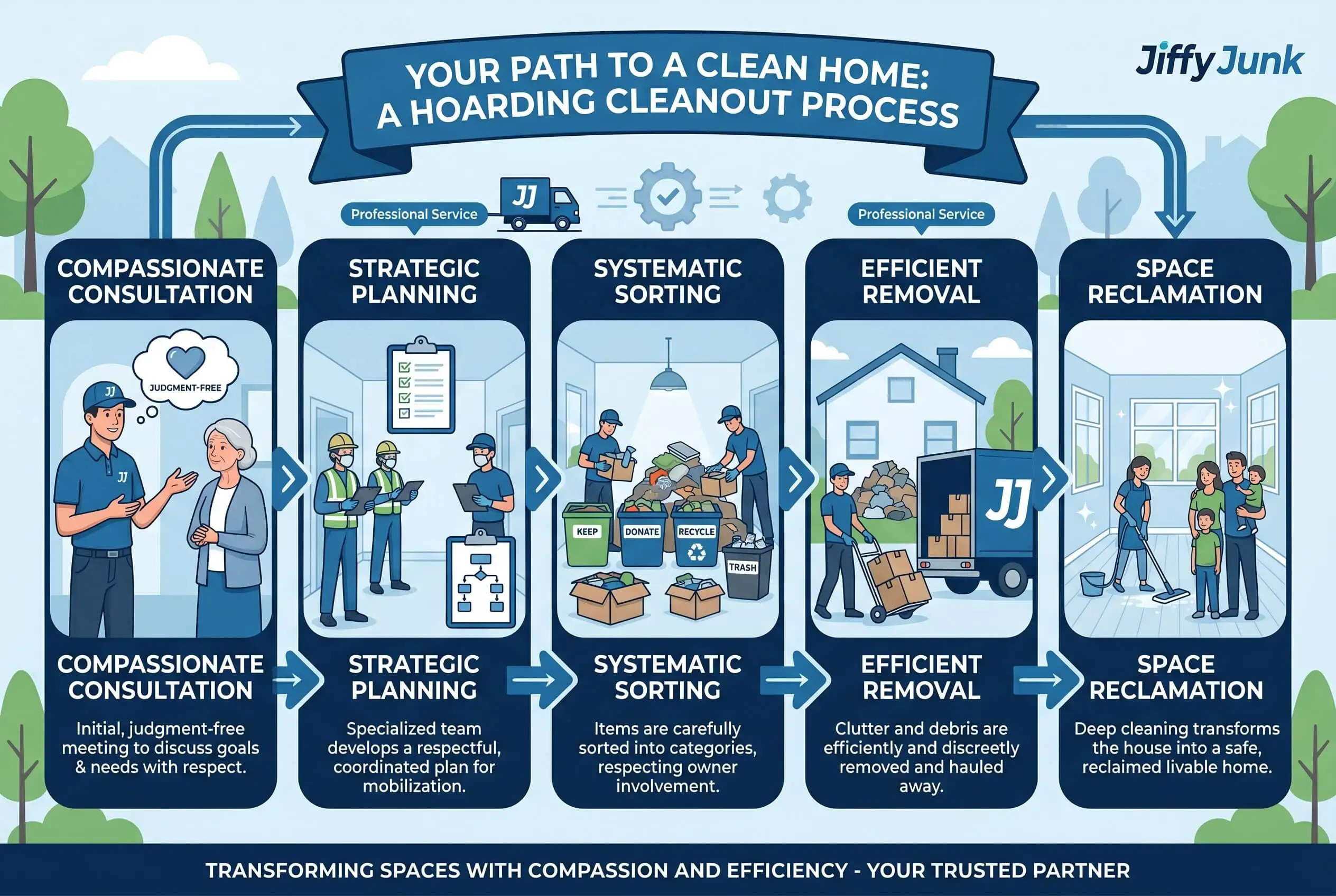
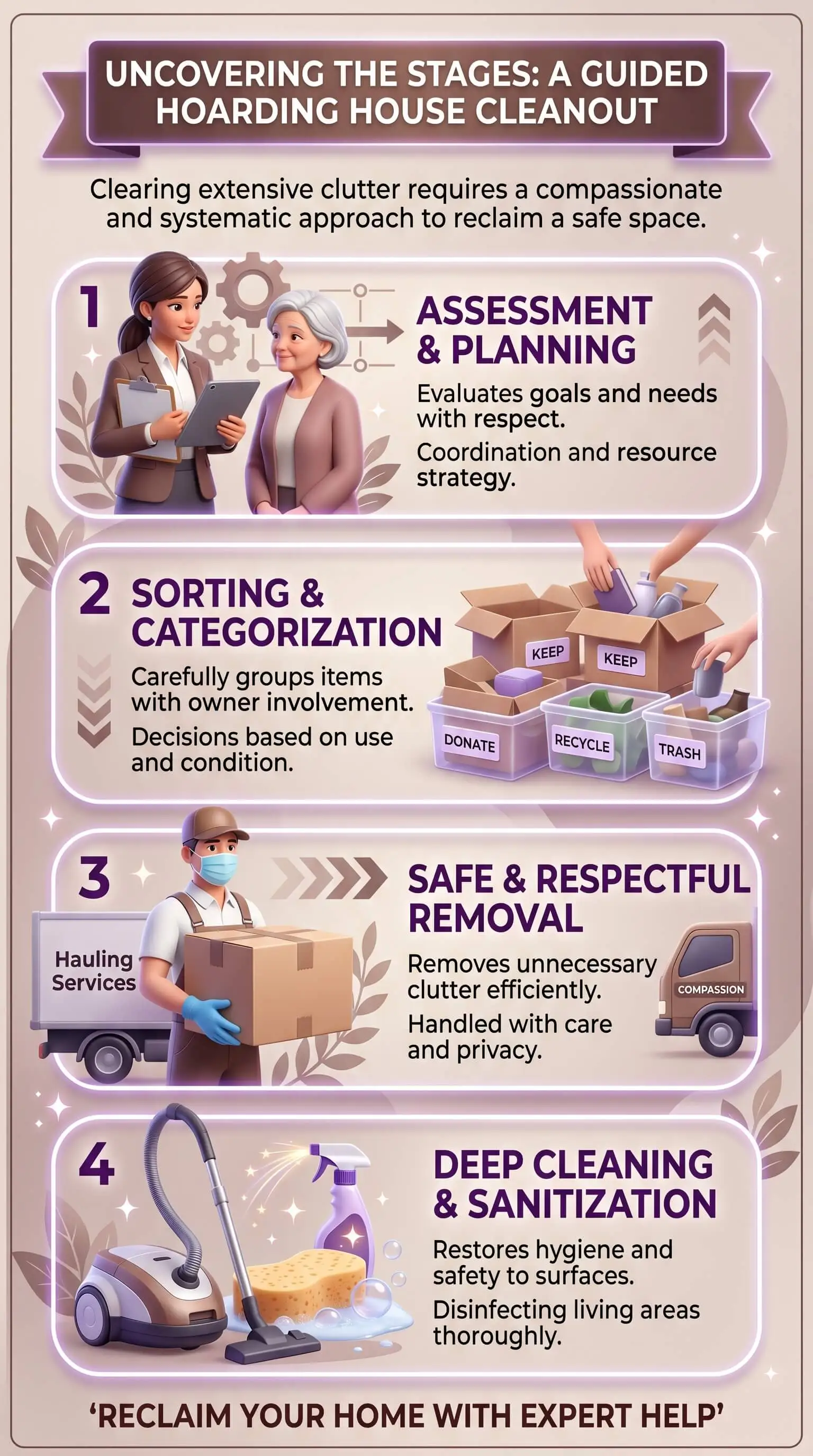
Nobody touches a single item until the whole property gets a proper walk-through. Our team documents square footage, notes the clutter severity (rated on a 1–5 scale), and flags anything that needs to come out before general hauling can begin — mold, pest activity, blocked exits, structural damage, biohazards. Photos go on file. A scope of work gets written up. The plan exists before the work starts, not halfway through it.
Step 2 — Create a Sorting Plan
Every item lands in one of four places: Keep, Donate, Sell, or Dispose. We work through those decisions with the homeowner or a family member, at whatever pace the situation calls for. When sentimental items are involved, this step takes longer than people expect. That's fine. A crew that pushes too hard here usually stalls the whole job. Our approach is patient, and that patience is what actually moves things forward.
Step 3 — Remove Hazardous Materials First
Human or animal waste, mold-damaged materials, needles, rotting food — these come out before the general cleanout starts. Our crews wear gloves, respirators, and disposable suits. This isn't an optional safety theater. Skipping proper PPE on a biohazard removal is a real health risk, and no responsible team does it.
Step 4 — Clear the Property Room by Room
Hauling happens from least-cluttered to worst. A staging area outside — driveway or yard — holds sorted items before they go to their final destination. We haul, sort, and haul again. On moderate-to-severe jobs, that cycle runs across multiple days and multiple truckloads. Landfill weight limits and dumpster capacity are part of the plan from day one.
Step 5 — Donate, Sell, or Dispose of Items
Usable items go to donation centers — Goodwill, Habitat for Humanity ReStores, local shelters. Things with resale value go to estate sale companies or online marketplaces. The rest gets hauled to licensed disposal facilities. Coordinating all of that while a cleanout is actively running is where a professional service pays for itself. The Jiffy Junk hoarding cleanout team handles sorting, hauling, donation logistics, and disposal together. You're not managing three separate vendors while trying to clear a home.
Step 6 — Deep Clean and Sanitize
Once the property is clear, the cleaning goes beyond what a standard service handles. Odors, surface contamination, and biological residue in a severely cluttered home need industrial degreasers, enzymatic neutralizers, and sometimes ozone treatment or antimicrobial fogging. Floors, walls, HVAC vents, and air duct cleaning all get attention. The space has to be livable before anyone moves back in.
Step 7 — Repair and Restore
Sustained weight damages flooring. Moisture and pests damage walls. Years of debris and poor air circulation damage HVAC systems. If the Step 1 assessment flagged structural issues, we coordinate with a contractor or remediation specialist before the job wraps — not after. Getting that lined up in advance keeps the timeline from collapsing at the end.
Step 8 — Final Walkthrough and Documentation
Every room gets a walkthrough with the property owner or their representative before our team leaves. When you book junk removal, you get a clearer, more accountable process: we document the cleared condition with photos, confirm that all agreed-upon kept items are present, and account for everything that was removed. That record matters for insurance claims, estate proceedings, and property sales. It also protects everyone involved.
“The jobs that go smoothest aren’t the ones with the least amount of stuff. They’re the ones where the family had a plan, the crew was trusted, and the person whose home it was had a real say in what stayed and what went. People underestimate how much that matters. When someone feels respected through the process — not rushed, not judged — the work moves faster and the results stick. The homes that get re-cluttered within a year are almost always the ones where the cleanout was done to someone instead of with them.”
7 Essential Resources
Whether you're planning a cleanout, supporting a family member, or just trying to get your bearings on what hoarding disorder actually is, these are the sources worth keeping open.
1. International OCD Foundation — Hoarding Disorder Resource Hub
The IOCDF's dedicated hoarding portal has a therapist and support group directory, family guides, and a task force locator for finding local help. It's the most complete public-facing hub for hoarding disorder in the U.S., and it's useful whether you're coordinating a cleanout or living through one.
2. American Psychiatric Association — Hoarding Disorder Patient Overview
psychiatry.org/patients-families/hoarding-disorder
The APA's patient page explains the clinical definition of hoarding disorder, how it differs from collecting, and what treatment looks like. Read this before you walk into a property — understanding what someone is dealing with changes how you approach the work.
3. USFA / FEMA — Hoarding and Fire Safety
usfa.fema.gov/prevention/home-fires/at-risk-audiences/hoarding/
The U.S. Fire Administration's official guidance on why cluttered homes carry higher fire risk, how blocked exits complicate emergency response, and what safety measures apply. This should be part of any pre-cleanout property review.
4. PubMed / NIH — Epidemiology of Hoarding Disorder
pubmed.ncbi.nlm.nih.gov/24158881/
A peer-reviewed study from the NIH on hoarding disorder prevalence, demographics, and associated health factors. It's the kind of source that puts the numbers in context when you're trying to explain the scope of a situation to someone who's never dealt with one.
5. PuroClean — How Much Does Hoarding Cleanup Cost?
puroclean.com — Hoarding Cleanup Cost Guide
A practical cost breakdown covering square footage pricing, labor rates, biohazard fees, and add-on services. Useful for anyone trying to budget a cleanout or understand why quotes from different companies vary as much as they do.
6. University of California Santa Cruz — Hoarding and Fire Risk (EHS)
ehs.ucsc.edu/fire-safety-and-prevention/community-outreach/hoarding-and-fire-risk/
This EHS page gets into the specific fire hazard mechanisms in hoarded homes — flammable items near heat sources, electrical wiring compromised by weight, blocked exit paths. A useful pre-cleanout safety reference for crews and families.
7. Institute for Challenging Disorganization — Clutter-Hoarding Scale
challengingdisorganization.org
The ICD's five-level Clutter-Hoarding Scale is what professional organizers and cleanup crews use to classify a hoarding situation before work begins. The level determines crew size, protective equipment, timeline, and cost. Knowing where a property sits on that scale is the first real planning decision.
3 Statistics
About 2.6% of U.S. adults meet the clinical criteria for hoarding disorder. That's roughly 6.5 million people.
The rate climbs to around 6% for adults over 60, and it holds consistent across countries. Given that a large portion of hoarding cleanouts involve older adults' primary residences, that age skew matters when you're planning a job. Source: American Psychiatric Association
Hoarding-linked fires are twice as likely to be fatal as other residential fires — 4.2% fatality rate versus 2.1%.
This comes from a 2020 study by Dozier & Porter that analyzed 5,194 residential fires. Hoarding fires also produced a higher injury rate: 8.3% versus 5.2%. A cleared property isn't just cleaner — it's safer. Source: Dozier & Porter, Journal of Public Health and Disaster Studies, 2020
Professional hoarding cleanouts for moderate cases typically run $3,000 to $10,000. Severe situations can exceed $25,000.
The range is wide because every job is different. Square footage, severity level on the 1–5 Clutter-Hoarding Scale, biohazard presence, and labor hours all factor in. Per-square-foot pricing runs $0.75–$2.50; labor adds $25–$60 per worker per hour. A property-specific quote is always the more accurate number. Source: PuroClean Disaster Restoration
Final Thoughts and Opinion
A real hoarding cleanout looks nothing like what gets shown on TV. The cameras cut before the second truckload. Before the biohazard call. Before the afternoon where everything stops because someone needs a minute to say goodbye to something that matters to them.
Here's our honest take: the single most important thing a family can do before starting a cleanout is agree on two things — who decides what stays, and who does the physical work. Trying to manage both at once, in a severely cluttered home, without professional support, turns a three-day job into three weeks. It costs more. And it wears everyone out.
A professional hoarding cleanout team brings more than a truck. We bring a system — protective gear, disposal contacts, donation logistics, and the experience to keep a job moving when it gets complicated. And it gets complicated. That's not a sales line; that's what Levels 3, 4, and 5 on the Clutter-Hoarding Scale actually look like.
If you found this page because you're somewhere in the middle of figuring all this out — that's the hard part. The plan is the hard part. Everything that comes after is just the work.
Frequently Asked Questions
How long does a hoarding cleanout take?
It depends on the home's size and how severe the clutter is. Most jobs run one to five days with a full professional crew. A standard home at Level 2 or 3 on the Clutter-Hoarding Scale typically takes two to three days. A Level 4 or 5 property — especially one with biohazard concerns or structural damage — can run a week or longer.
How much does a hoarding cleanout cost?
Moderate cases typically run $3,000 to $10,000. Severe situations — large square footage, biohazards, multiple truckloads — can exceed $25,000. Pricing is usually based on a mix of square footage ($0.75–$2.50 per sq ft), labor hours ($25–$60 per worker per hour), and disposal volume. An on-site estimate gives you a real number.
Can I do a hoarding cleanout myself, or do I need a professional?
For mild clutter at Level 1 or 2, a motivated family with enough time can handle it. Anything involving biohazards, structural issues, or a home where clutter has fully taken over the living space calls for a professional team. The risks — health hazards, injury from unstable stacks, improper disposal of regulated materials — aren't theoretical.
What happens to items removed during a hoarding cleanout?
Usable items in good condition go to donation centers: Goodwill, Habitat for Humanity ReStores, local shelters. Things with resale value go to estate sale companies or online marketplaces. Everything else goes to licensed landfill or recycling facilities. A professional team handles all three, along with related cleanup needs like air duct cleaning, so you don't have to coordinate them separately.
Is a hoarding cleanout covered by homeowner's insurance?
Sometimes, but not reliably. Insurance may cover cleanup costs when hoarding-related conditions caused documented property damage — mold, water damage, structural issues — depending on the specific policy. Long-term accumulation without a clear triggering event is generally not covered. Check your policy and contact your insurer before assuming it applies.
How do I know what level of hoarding I'm dealing with?
The Institute for Challenging Disorganization's Clutter-Hoarding Scale uses a 1–5 rating based on four factors: structure and zoning, pets and rodents, household functions, and health and safety. Level 1 is minor clutter. Level 5 may involve structural compromise, no working utilities, and hazmat protocols before entry. Our team assesses the level during the initial walk-through.
Ready to Get Started?
You don’t have to sort this out alone.
Whether it’s one room or an entire property, full service junk removal gives you a clearer, easier way forward by covering the removal, hauling, disposal, and cleanup process before anyone commits to anything. Call us, fill out the booking form, or just send a message. No pressure. No judgment. Just a straight answer and a plan.